
- Kripto Al
- Piyasalar
- Vadeli İşlemler
- Spot
- Copy Trade
 Kazan
Kazan- Daha Fazla
120,000 Bitcoins Seized? In-Depth Analysis of the Regulatory Dilemma Behind the "Prince Group" Case

Introduction
In the current environment of tightening global cryptocurrency regulations, a cross-border "online pursuit" spanning Cambodia, the United States, and the United Kingdom has attracted everyone's attention. In October 2025, the U.S. Department of the Treasury and the Department of Justice joined forces to conduct the largest-ever cryptocurrency enforcement operation against the Prince Group in Cambodia, freezing up to 120,000 bitcoins.
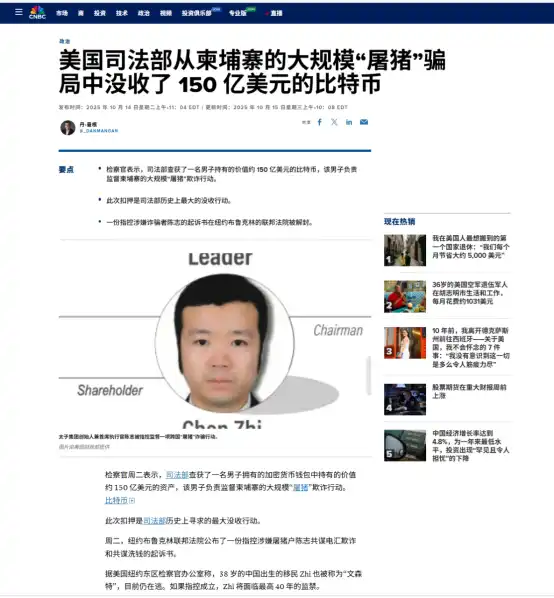
(Image source: U.S. CNBC Channel)
This case has not only shaken the blockchain industry but also challenged our traditional understanding of "financial sovereignty": when digital assets cross borders and flow anonymously, how can a sovereign state technologically track, legally sanction, and take back control in enforcement? When the U.S. is able to extend its law enforcement reach through the financial network, how can we establish our own digital asset tracing and judicial disposal system?
This article will delve into the case review, legal basis, technical vulnerabilities, and regulatory insights to analyze the legal logic and international regulatory dilemma behind the "Prince Group" case and attempt to answer an increasingly urgent question—In the era of digital finance, who truly holds the sovereignty of enforcement?
1. Case Review
First, let us reconstruct the specific details of the Prince Group case as much as possible to analyze its significance.
In October 2025, the U.S. Department of the Treasury's Office of Foreign Assets Control (OFAC) initiated one of the largest single judicial strikes against the "Prince Group International Crime Organization," sanctioning 146 members. Subsequently, the U.S. Department of Justice (DOJ) announced indictments: charging Chen Zhi with organizing and operating a "pig butchering" type of cryptocurrency investment scam based on forced labor campgrounds, while also conspiring in telecommunications fraud and money laundering. What was truly surprising was the DOJ's claim to have seized over 127,000 bitcoins.

(Image source: U.S. Department of Justice website)
How were these bitcoins scammed in the first place? It's actually quite simple. According to the indictment, Chen Zhi led the Prince Group in conducting large-scale online investment scams, deceiving victims to invest in dollars or cryptocurrency, displaying their account balances or profit growth on the surface platform, but the funds had actually been transferred out long ago, concentrated into wallets controlled by Chen Zhi. Additionally, the Prince Group made investments into mining companies such as LuBian Mining or leased real mining rigs, purchasing hash power from the open market to make outsiders believe they were acquiring bitcoin through mining, giving them the appearance of "legitimate generation."
Regarding such a massive scale cryptocurrency scam, there are reports that China established a task force in Beijing five years ago to investigate this case. However, due to the long time span, we were unable to find official information or news on this matter and could only find references from various media outlets, so we cannot easily determine the veracity of these claims. Nevertheless, how did the United States and the United Kingdom suddenly seize such a large amount of Bitcoin and extend their enforcement reach to Cambodia in the Far East?
1. Source of U.S. Jurisdiction
The indictment clearly states that the PlusToken scam network, with global victims including the United States, operated a local network in the Brooklyn area of New York. Victims were deceived into transferring funds to shell company accounts in Brooklyn and Queens, which were then circulated back to PlusToken and accounts controlled by Chen Zhi through international wire transfers or cryptocurrency transactions. This means that these accounts were opened at U.S. financial institutions and cleared through U.S. financial institutions. According to the U.S. Constitution, territorial jurisdiction is established as long as any part of the criminal activity occurs in or has an effect in the United States. The indictment also clearly states that since the criminal conduct and consequences occurred in that area, this case falls under the jurisdiction of the Eastern District of New York federal court.
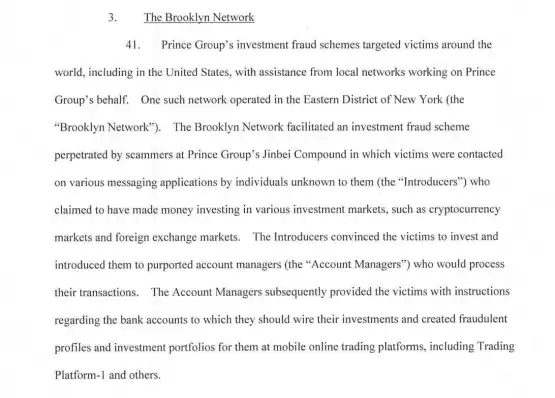
(The above image is excerpted from the original indictment)
2. Why Could Enforcement Proceed Smoothly?
On the criminal front, U.S. law enforcement agencies obtained a restraining order for 127,271 bitcoins controlled by Chen Zhi as proceeds of crime under the Civil Asset Forfeiture Reform Act (18 U.S.C. §§ 981, 982). On the financial sanctions front, the U.S. Treasury Department designated PlusToken and its associated financial network as a "Primary Money Laundering Concern" under section 311 of the Patriot Act (31 U.S.C. § 5318A), enabling the immediate freezing of its U.S.-related accounts and transactions. Combined with the Global Magnitsky Human Rights Accountability Act (22 U.S.C. § 2656), which allows for global asset freezes and transaction bans on the assets of foreign individuals involved in serious human rights abuses or significant corruption.
Additionally, by leveraging Rule 41 of the Federal Rules of Criminal Procedure and the Mutual Legal Assistance Treaty (MLAT) mechanism, the United States was able to smoothly execute seizure, extradition, and asset disposal measures through blockchain custodial nodes, exchanges, and multilateral cooperation.
3. Technical Vulnerabilities Suspicions
Why can the United States easily freeze Bitcoin storage? In addition to the strong on-chain team behind the United States, the encrypted salad also heard an interesting statement from a well-known blockchain forensics and compliance technology institution, Elliptic Blog, which can be shared with all readers:
At the end of 2020, a mining company named LuBian Mining (yes, the one mentioned earlier) experienced a serious security incident. In short, the algorithm for generating the private key for opening the Bitcoin safe had a random number vulnerability (also known as "Milk Sad"), allowing attackers to crack the private key and transfer all the Bitcoins in their mining pool, reportedly totaling exactly 127,000 coins. Until June-July 2024, new activity was detected from these Bitcoins, and the wallets involved in this new activity overlapped or merged with wallets controlled by the Prince Group network and Chen Zhi. Ultimately, in 2025, the U.S. Department of Justice officially seized them.
Undoubtedly, a considerable portion of the 127,000 Bitcoins frozen in the Prince Group had contributions from the Chinese community. However, under the current legal and technical framework, we can hardly recover our own interests from it. Regardless of whether a country has initiated an investigation or taken action, the "Prince Group" case has sounded the alarm for us: in the digital financial era, financial sovereignty is not only reflected in currency issuance but also in the effective exercise of law enforcement sovereignty. When transnational crimes are exposed, we must have clear legal grounds, a mature technical system, and resolute law enforcement capabilities to truly protect and recover assets that rightfully belong to us.
II. Conclusion
The "Prince Group" case is not the first and will not be the last of such cases. It profoundly reminds us that while the original regulatory policies may have achieved their intended goals, they may also cause us to lose some initiative in the new round of global financial competition.
Faced with the inevitable trend of digital assets, we must find a new balance between "strict risk control" and "sovereignty grasp." Establishing a self-controlled digital asset judicial disposal system to ensure that our country's legal dignity and law enforcement capabilities can extend to the digital space is an urgent issue. Only in this way can we truly achieve "asset recovery according to the law" in the future, whether it be confiscating assets to enrich the national treasury or proportionally settling and returning them to victims, thereby completing the final loop of law enforcement and effectively safeguarding the property security of the people.
This article is a submission and does not represent the views of BlockBeats.
Ayrıca bunları da beğenebilirsiniz

Bitcoin Fiyatındaki Hareketler: CEX Üzerindeki Etkileri
Key Takeaways Bitcoin’in 92,262 dolar barajını aşması durumunda CEX’lerde gerçekleşecek toplam short pozisyon tasfiyesi 17.1 milyar dolara ulaşacak.…

Untitled
Kripto Para Piyasasında Dalgalar: Yanıt Veremeyen Bitcoin Key Takeaways Japonya’da on yıllık tahvil faizleri %2.29 seviyesine yükselerek piyasalarda…

Cathie Wood Ark Invest Yatırımları Arttırıyor
Key Takeaways Cathie Wood’un ARK Invest, Coinbase’in (COIN) hisselerini artırarak toplam 2180 milyon dolarlık kripto hisse alımı gerçekleştirdi.…

ABD Merkez Bankası Faiz Kararı Bitcoin ve Dolar Üzerinde Nasıl Etkili Olabilir?
Key Takeaways ABD Merkez Bankası’nın (FED) 2026 yılının ilk faiz kararı bu hafta açıklanacak, faiz oranlarının değişmemesi bekleniyor.…

Untitled
Outline H1: Dolar Endeksi Düşerken Bitcoin Yeni Bir Yükseliş Dalgasına Giriyor mu? Key Takeaways Dolar endeksi (DXY) 97…

Untitled
Bitcoin’in Fiyat Çöküşü: Makro Riskler ve Destek Seviyeleri Key Takeaways ABD’de hükümetin kapanma riski artarken Bitcoin fiyatı 88.000…

Untitled
Outline H1: Kripto Piyasasında Büyük Likidasyon Dalgası: 24 Saatte 7.66 Milyar Dolar H2: Son 24 Saatte Gerçekleşen Likidasyonlar…

Bitcoin Büyük Kayıpla Karşı Karşıya: 45 Milyar Doları Aştı
Key Takeaways Bitcoin’in gerçekleştirdiği finansal kayıplar 45 milyar dolara ulaşarak son üç yılın en yüksek seviyesine çıktı. Bu…

Anonim Adresler Arasında Büyük Bitcoin Transferleri Gerçekleşti
Key Takeaways 200.48 BTC değerindeki büyük bir işlem anonim adresler arasında taşındı. Bitcoin transferi, toplam 199.13 BTC’nin başka…
Bitcoin CME Boşluğu Piyasa Yönünü Etkiliyor
Key Takeaways Bitcoin’in CME vadeli işlemlerinde hafta sonu yaşanan açılış ve kapanış fiyatları arasındaki boşluk, piyasa tarafından dikkatle…

ABD Hükümeti Kapanma Riski Kripto Piyasalarına Darbe Vuruyor
Key Takeaways ABD hükümeti kapanma olasılığı 31 Ocak’a kadar %80’e yaklaştı ve bu durum kripto piyasalarını olumsuz etkiliyor.…
BTC fiyatında düşüş evresi sona eriyor: Bu hafta Bitcoin’de bilmeniz gereken beş şey
Key Takeaways Bitcoin 2026 yılı kapanışına yaklaşırken önemli destek seviyelerinin altında hareket ediyor ve yeni düşük seviyeler mümkün…

Kripto Fonlarından 1,7 Milyar Dolarlık Çıkış: Kasım 2025’ten Bu Yana En Büyük Hareket
Crypto ETP’lerden 1,73 milyar dolarlık çıkış yaşandı, bu rakam Kasım 2025’ten bu yana en büyük çıkış olarak kaydedildi.…

Restaking vaat edilen getiriyi sağlamaz ve yalnızca risk yığar
Key Takeaways Restaking, zaten stake edilmiş varlıkları bir kez daha teminat olarak kullanarak potansiyel getiriler sunarken, aslında önemli…

Bitcoin Coinbase Premium negatif yönünü sürdürüyor: Sırada $66K BTC fiyatı mı var?
Bitcoin fiyatı $87,000’nın altına düşerek önceki destek seviyelerini gözden geçiriyor. Coinbase Premium 12 aylık en düşük seviyelerine ulaştı,…

Bitcoin nodes running BIP-110 oranı %2’yi geçti ve spam savaşları hararetleniyor
Key Takeaways BIP-110, Bitcoin ağındaki non-monetary işlemlerden kaynaklanan spam’ları önlemeyi amaçlayan geçici bir soft fork’tur ve %2.38 node…

ABD Bitcoin ETF’leri Outflow Zincirini Sürdürüyor: Kripto Piyasası Duyarlılığı Düşüşte
Anahtar Bilgiler Son beş gündür ABD tabanlı Bitcoin ETF’leri toplamda 1.72 milyar dolarlık çıkış yaşadı. Kripto piyasası duyarlılık…
Bitcoin haftalık kapanışa doğru çökerken boğalar 86K BTC fiyat hesaplaşmasıyla karşı karşıya
Önemli Çıkarımlar Bitcoin, haftalık kapanış öncesinde değer kaybederek makroekonomik belirsizliklerin ön planda olduğu bir haftaya giriyor. Piyasa analistleri,…
Bitcoin Fiyatındaki Hareketler: CEX Üzerindeki Etkileri
Key Takeaways Bitcoin’in 92,262 dolar barajını aşması durumunda CEX’lerde gerçekleşecek toplam short pozisyon tasfiyesi 17.1 milyar dolara ulaşacak.…
Untitled
Kripto Para Piyasasında Dalgalar: Yanıt Veremeyen Bitcoin Key Takeaways Japonya’da on yıllık tahvil faizleri %2.29 seviyesine yükselerek piyasalarda…
Cathie Wood Ark Invest Yatırımları Arttırıyor
Key Takeaways Cathie Wood’un ARK Invest, Coinbase’in (COIN) hisselerini artırarak toplam 2180 milyon dolarlık kripto hisse alımı gerçekleştirdi.…
ABD Merkez Bankası Faiz Kararı Bitcoin ve Dolar Üzerinde Nasıl Etkili Olabilir?
Key Takeaways ABD Merkez Bankası’nın (FED) 2026 yılının ilk faiz kararı bu hafta açıklanacak, faiz oranlarının değişmemesi bekleniyor.…
Untitled
Outline H1: Dolar Endeksi Düşerken Bitcoin Yeni Bir Yükseliş Dalgasına Giriyor mu? Key Takeaways Dolar endeksi (DXY) 97…
Untitled
Bitcoin’in Fiyat Çöküşü: Makro Riskler ve Destek Seviyeleri Key Takeaways ABD’de hükümetin kapanma riski artarken Bitcoin fiyatı 88.000…


 App
App