
- Buy Crypto
- Markets
- Futures
- Spot
- Copy Trade
 Earn
Earn- More
Ethereum returns to $4,000. Have the fundamentals of the ecosystem really changed?

After the bull market correction phase in the past few days, the price of ETH has once again reached $3,900. Looking back on the development of Ethereum over the past year, there are many complex factors and emotions. On the one hand, the Cancun upgrade was successfully completed and the spot ETF was officially passed, ushering in a new bull market in terms of technology and fundamentals; but on the other hand, as Bitcoin, SOL, and BNB broke through historical highs one after another, the price of ETH is still hovering around the $4,000 mark.
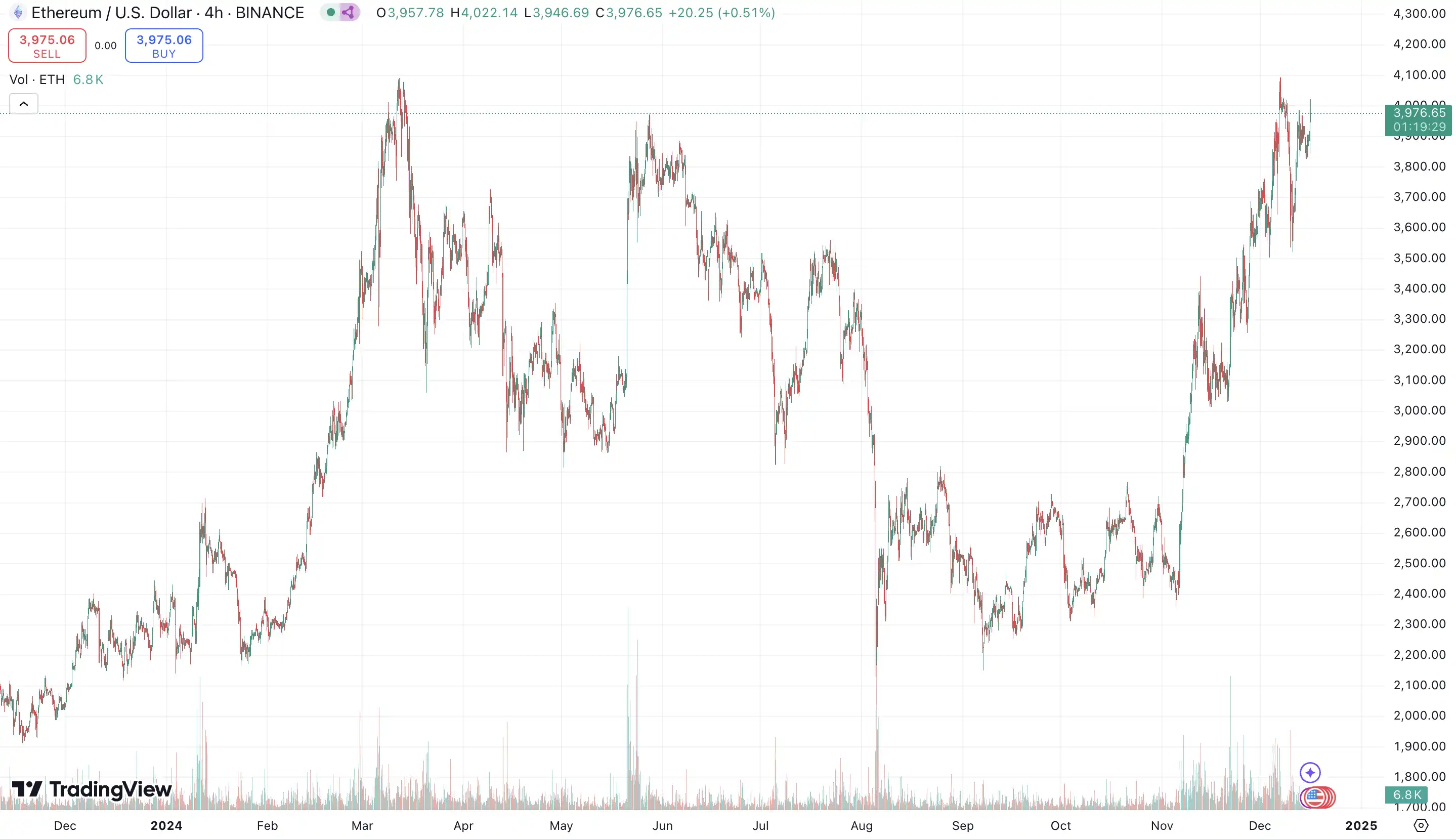
From the above ETH price trend chart this year, it can be seen that Ethereum has gone through three major stages this year, and the rise in the three stages corresponds to different reasons. At the beginning of the year, the Bitcoin spot ETF was passed, and the price of Ethereum followed the market sentiment and rose, breaking through $4,100 at one point, but at the end of March, it also began to fall with the market. Because of the strong rise of SOL and its ecology, the Ethereum ecosystem is facing a large amount of liquidity outflow.
In May, the Ethereum spot ETF was approved, and the price briefly surged, but its demand was not as strong as that of Bitcoin. The market's initial reaction to the launch of the Ethereum ETF was negative, as speculative investors who bought the Grayscale Ethereum Trust and expected it to be converted into an ETF took profits, resulting in a $1 billion outflow of funds, which put downward pressure on the price of Ethereum. In addition, ETH's narrative of leaning towards scientific and technological products is less likely to impress the traditional market than BTC's "digital gold", and the SEC's restriction on Ethereum spot ETFs from engaging in staking functions has objectively weakened its appeal.
After that, the Ethereum Foundation, the re-staking ecosystem, and the roadmap disputes followed one after another, and Ethereum ushered in a dark moment.
In November, the dust settled on the US election, and the pro-crypto Republican Party and Trump brought stronger confidence and liquidity injection to the entire crypto ecosystem, and Ethereum also ushered in the third wave of increases this year. This time the rise is different from the past. Institutions have entered the market openly. The improvement of liquidity fundamentals is the market using funds to tell us what institutions recognize and are optimistic about; and Ethereum is destined to continue its original intention of "world computer".
Improvement of liquidity fundamentals
Since December, Ethereum spot ETF has had a net inflow of more than 2.2 billion US dollars for half a month. Nate Geraci, president of The ETF Store, said on the social platform that consultants and institutional investors have just begun to pay attention to this field.
In the third quarter of this year, banks such as Morgan Stanley, JPMorgan Chase and Goldman Sachs significantly increased their holdings of Bitcoin ETFs, and their holdings almost doubled quarter-on-quarter, but their investment scope is not limited to Bitcoin. According to the latest 13F documents, these institutions have also begun to buy Ethereum spot ETFs since then.
In addition, in the first two quarters, the Wisconsin Investment Committee and the Michigan Retirement System purchased Bitcoin spot ETFs respectively. In the third quarter, Michigan further purchased Ethereum spot ETFs worth more than $13 million. This shows that pension funds, which symbolize low-risk preferences and long-term investments, not only recognize Bitcoin as a digital value store, but also value Ethereum's growth potential.
When the Ethereum spot ETF was first passed, JPMorgan Chase pointed out in a report that the demand for Ethereum spot ETFs would be much lower than that for Bitcoin spot ETFs. However, the report predicts that the spot Ethereum ETF will attract up to $3 billion in net inflows for the rest of the year. If staking is allowed, this figure may be as high as $6 billion.
Jay Jacobs, head of U.S. thematic and active ETFs at BlackRock, said at the "ETFs in Depth" conference that "our current exploration of Bitcoin, especially Ethereum, is just the tip of the iceberg. Only a very small number of clients hold (IBIT and ETHA), so our current focus is on this aspect, rather than launching new altcoin ETFs."
In a Blockworks Research surveyreport, the vast majority (69.2%) of respondents currently hold ETH, of which 78.8% are investment companies or asset management companies, indicating that driven by income generation and network security contributions, the willingness of institutions to participate in ETH staking has reached a critical scale.
Institutions are actively participating in ETH Staking, but the degree of participation and methods vary. Regulatory uncertainty has led to different attitudes from all parties, with some institutions acting cautiously while others are less concerned, and institutional participants are highly aware of the operational aspects and risks associated with staking.
The Tide Reverses
Since the collapse of FTX, Coinbase, Kraken, Ripple and others have been severely cracked down by US regulators such as the SEC, and many crypto projects cannot even open accounts in mainstream US banks. In the last bull market, traditional financial institution investors who entered the market due to DeFi also suffered huge losses. Large funds such as Toma Bravo, Silver Lake, Tiger, and Cotu not only suffered setbacks on FTX, but also invested in some crypto projects at high valuations that did not deliver on their grand promises, and the funds have not yet returned.
In the second half of 2022, many DeFi projects were forced to move outside the United States. According to Alliance DAO founder qw, "Two years ago, about 80% of crypto startups that met the criteria were located in the United States. However, this proportion has continued to decline since then and is currently only about 20%."
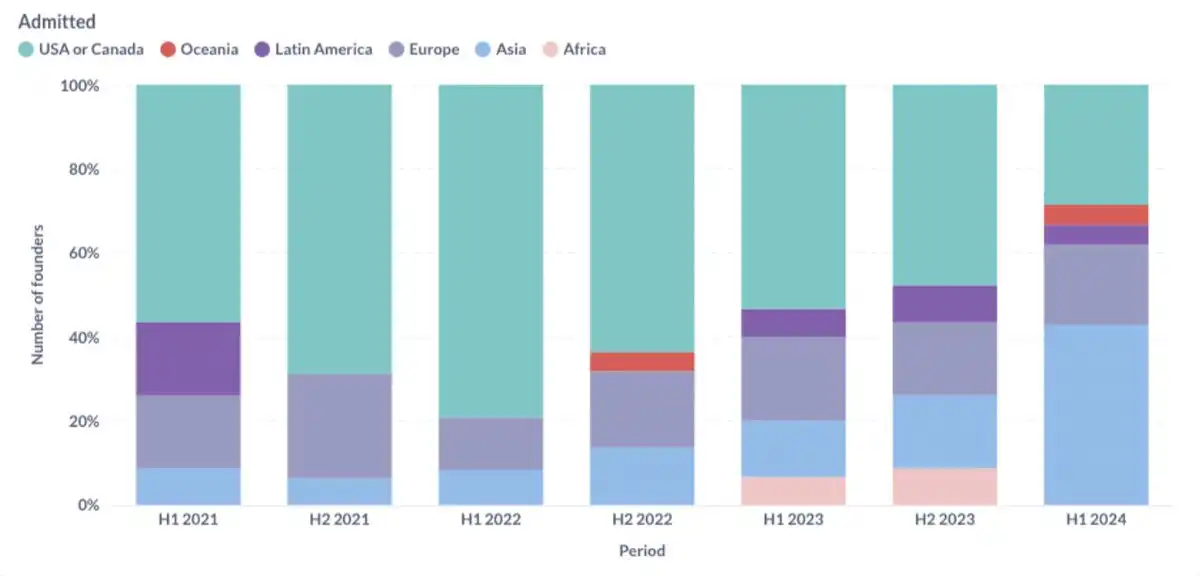
But on November 6, Trump won the election, and the green light that the U.S. financial system had been waiting for was on.
Trump Saves the Cryptocurrency
Trump's victory undoubtedly cleared the regulatory clouds for institutional adoption.
After establishing the Department of Government Efficiency, directly gathering a series of Wall Street financial elites such as Musk, Peter Thiel, and Marc Andreessen under his command, and appointing Paul Atkins as the chairman of the SEC, Trump also appointed PayPal co-founder David Sacks as the "White House Director of Artificial Intelligence and Cryptocurrency Affairs." A series of measures show that Trump will create a government with loose crypto regulation.
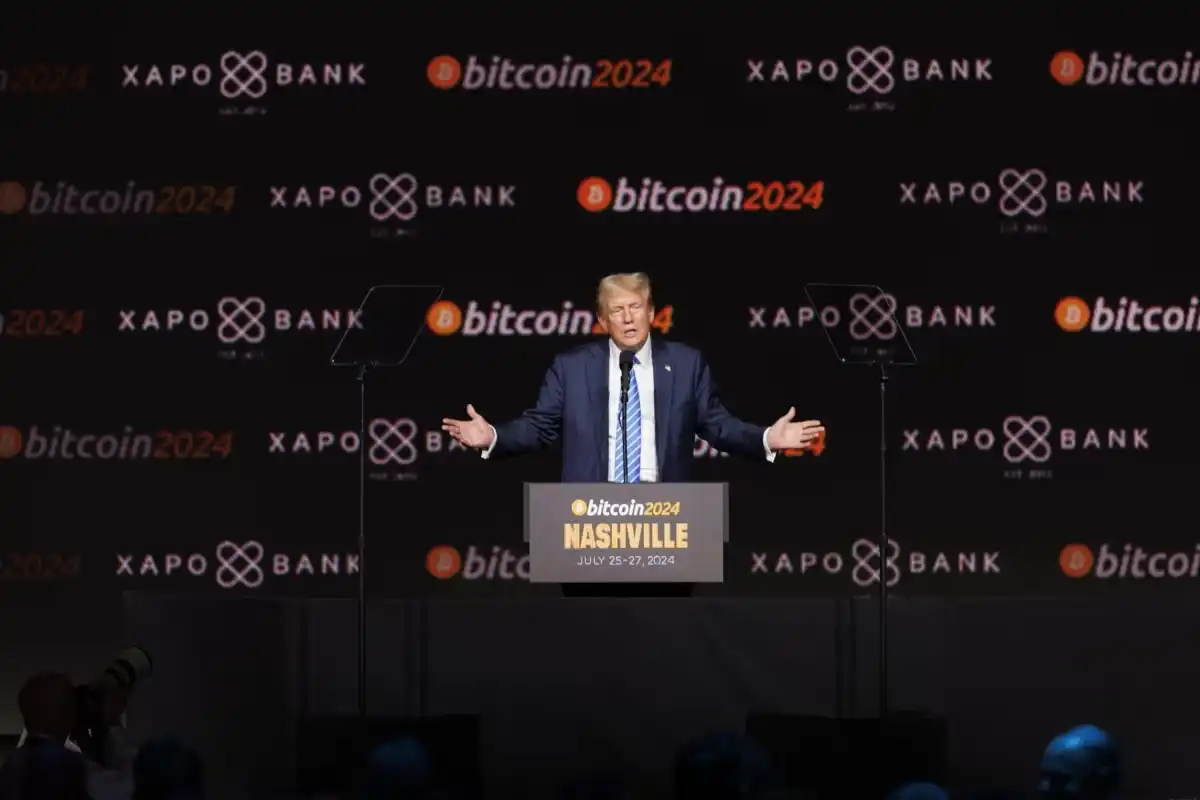
Related reading: "The White House will usher in an era of crypto-friendly: a detailed account of the "crypto-team" under Trump's leadership"
Analysts at JPMorgan Chase said that several stalled cryptocurrency bills after Trump took office may be quickly approved, including the 21st Century Financial Innovation and Technology Act (FIT21), which may provide much-needed regulatory clarity for the crypto industry by clarifying the regulatory responsibilities of the SEC and CFTC. And said that as the regulatory framework becomes clearer, the SEC's strategy of increasing enforcement may evolve into a more collaborative approach, and its "Staff Accounting Bulletin No. 121" (SAB 121) that restricts banks from holding digital assets may be repealed.
High-profile lawsuits against companies like Coinbase could also be mitigated, settled or even dropped. Regulatory notices to companies like Robinhood and Uniswap could be reconsidered, reducing litigation risk for the broader crypto industry,
In addition to department and bill reforms, the Trump team is considering drastically cutting, merging or even eliminating major banking regulators in Washington. People familiar with the matter said that when interviewing potential bank regulators, Trump advisers asked some people in the Department of Government Efficiency whether the Federal Deposit Insurance Corporation (FDIC) could be abolished. Trump advisers also asked potential candidates for the Federal Deposit Insurance Corporation and the Office of the Comptroller of the Currency. In addition, it has proposed plans to merge or overhaul the Federal Deposit Insurance Corporation, the Office of the Comptroller of the Currency and the Federal Reserve.
As policy dividends are gradually released, larger institutional funds in the US market are expected to return to the crypto market.
DeFi revival in progress
Family offices, endowment funds, pension plans and other more stable capital will not only deploy Ethereum spot ETFs, but will also re-enter the DeFi field that has been verified in the previous cycle.
Compared with 2021, the total supply of stablecoins has reached its highest level, and in the more than one month since Trump's victory, the total amount of stablecoins has been issued by nearly $25 billion, and the current total market value of stablecoins is $202.2 billion.
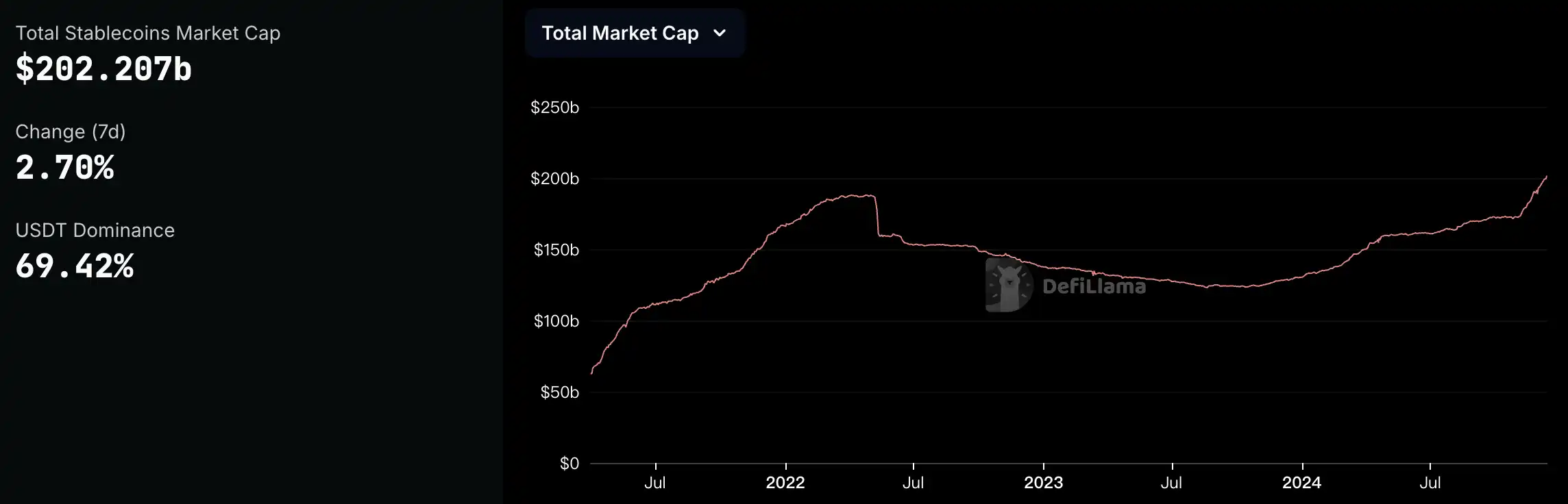
As the leader of US crypto listed companies, Coinbase has made achievements in the DeFi field this year in addition to its political contributions. On the one hand, it is the largest crypto ETF custodian, and on the other hand, it has launched cbBTC.
Since cbBTC faces the same custody and counterparty risks as most Bitcoin ETFs, some traditional financial institutions may reevaluate whether to continue paying fees to hold Bitcoin ETFs and instead turn to participating in the DeFi ecosystem at almost zero cost. This shift may bring inflows of funds to market-tested DeFi protocols, especially when the yields offered by DeFi are more attractive than those of traditional finance.
Another major DeFi sector in this cycle is RWA. In March this year, BlackRock issued the tokenized fund BUIDL (BlackRock USD Institutional Digital Liquidity Fund) in cooperation with the US tokenization platform Securitize, and officially entered the RWA track with a rather high-profile attitude. Capital giants such as Apollo and Blackstone, which have huge pools of funds, are also beginning to prepare to enter this market and bring in a large amount of liquidity injection.
After the Trump family launched the DeFi project, compliant DeFi has been a hot topic. Uniswap, Aave, Lido and other Ethereum blue-chip DeFi projects immediately responded to Trump's victory in price, and they all rose and broke through, while rising stars in the DeFi sector such as COW, ENA, ONDO also reached new highs.

At the same time, Trump's encrypted DeFi project WLFI has also frequently traded Ethereum tokens recently. After exchanging 5 million USDC for 1,325 ETH in multiple transactions, its multi-signature address bought $10 million in ETH, $1 million in LINK and $1 million in AAVE respectively. Recently, there have been continuous reports of whales increasing their holdings of ETH, suggesting that both institutions and whale accounts are returning to the Ethereum ecosystem.
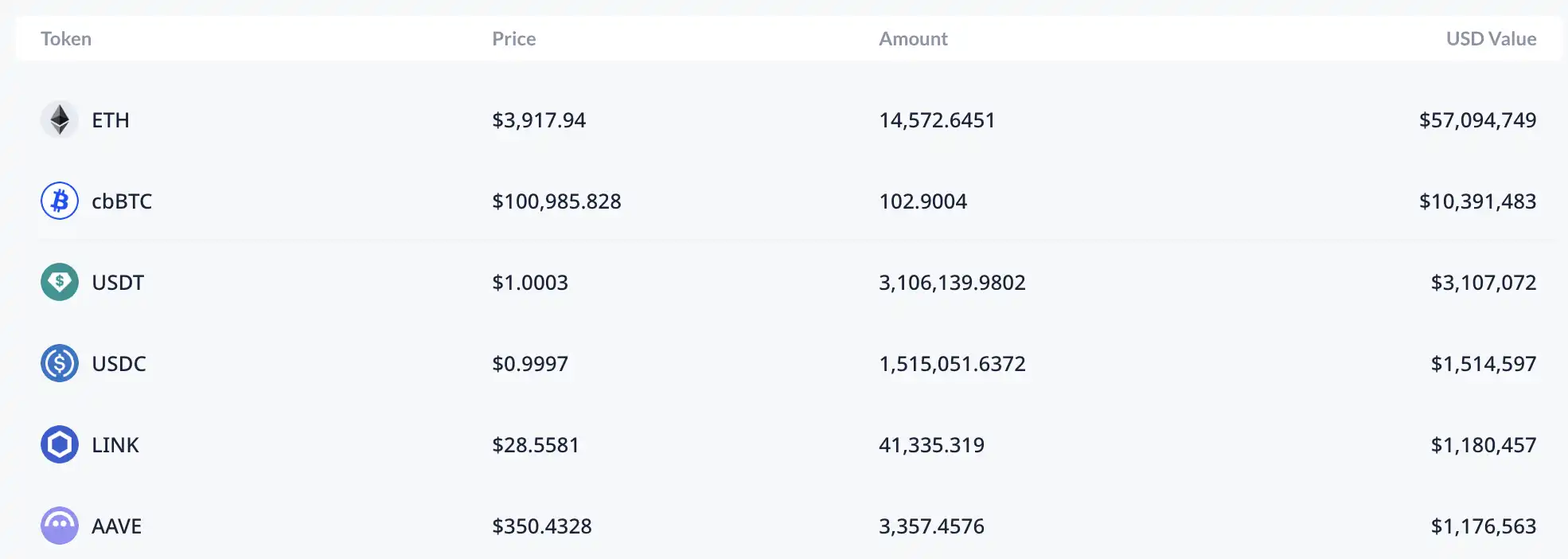
WLFI multi-signature address holding information
The recent performance of new and old projects in the DeFi track at the price level is beyond words. At present, the TVL of DeFi is about 100 billion US dollars, and the total value of current cryptocurrencies and related assets is about 4 trillion US dollars. Among them, the funds that are truly active in the DeFi field only account for 2%, which is still small compared to the size of the entire cryptocurrency market. This means that with the warming regulatory wind, DeFi still has huge room for growth.
Aave is a typical beneficiary of this round of "capital repatriation". Its price broke through before Trump won the election, and since then, TVL and revenue have shown explosive growth: TVL broke through the historical high of 22 billion US dollars in October 2021; the token price has risen from the low of 80 USDT this year, breaking through the March high of 140 USDT in early September and accelerating in late November; the protocol's daily total revenue exceeded the secondary peak in September 2021, and the weekly revenue hit a record high.
Although Aave recently upgraded to V4, the driving force of innovation at the technical level may not be enough to support such a large-scale increase. The promotion of supervision and capital is obviously a more important logic, and even this promotion will overflow to the NFT track that was also favored by institutions in the last cycle.
The Future of Ethereum
Ethereum encountered a series of controversies and discussions related to ecological development in the middle of this year. With the rise of Solana, the new old blockchain began to seize Ethereum's developers and user base, and the ecosystem began to waver. Ethereum seemed to have forgotten its original goal. As the first blockchain to build smart contracts, Ethereum successfully made major institutional investors pay for it in the last cycle through its first-mover advantage. Whether it is DeFi, chain games, NFTs, or the metaverse, they cannot escape the Ethereum ecosystem, and its original intention of "world computer" has been deeply rooted in the hearts of the people.
Although the current liquidity fundamentals of Ethereum have optimistic improvements, from the perspective of Ethereum itself, its daily average number of transactions, gas fees, number of active addresses and other on-chain data indicators have not increased significantly. This shows that the activity on the Ethereum chain has not increased synchronously with its price, and block space is still in excess.
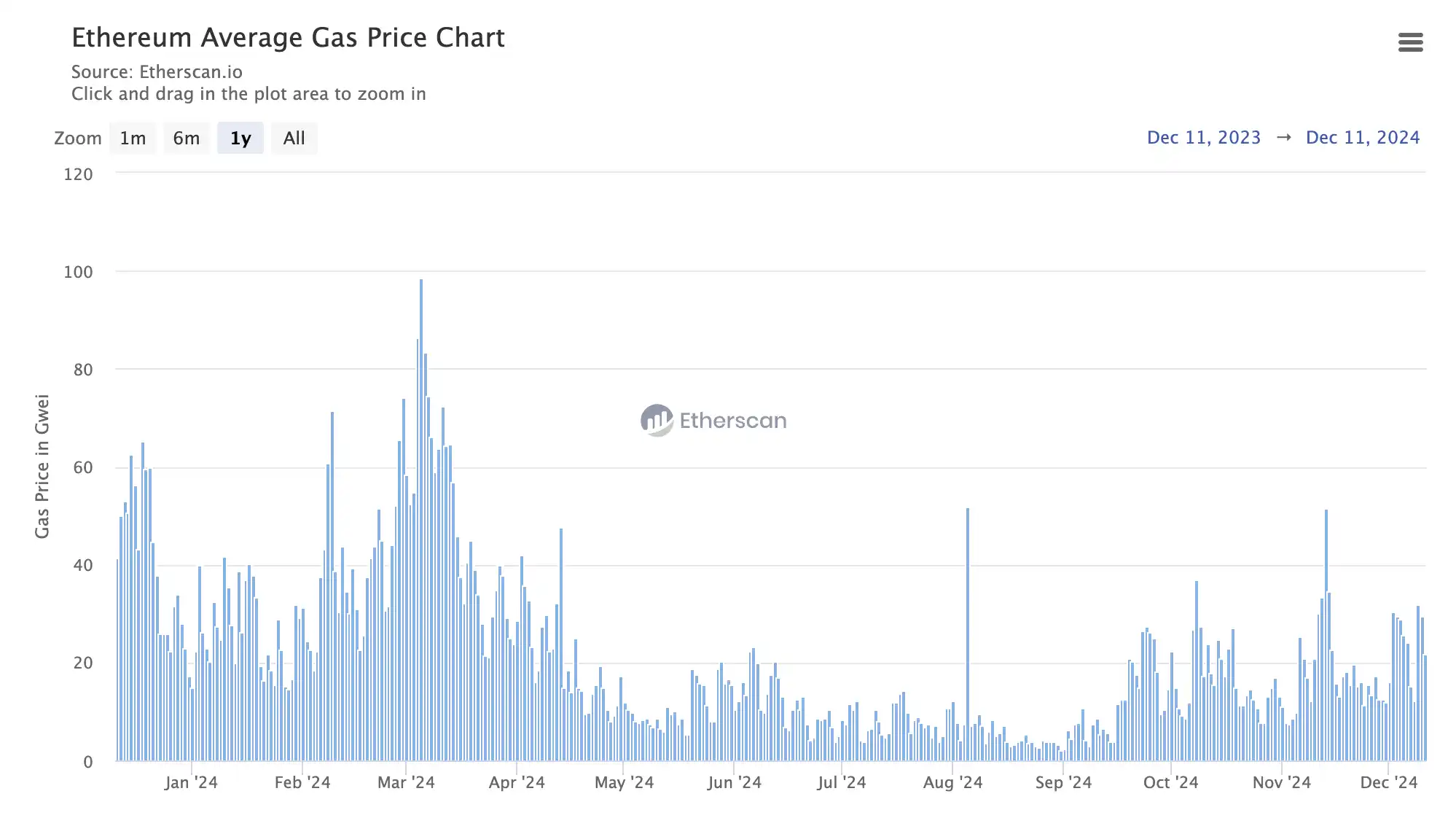
Ethereum Gas Fee Level
In the past few years, Ethereum has focused on building the infrastructure of cryptocurrency, providing the market with a large amount of cheap block space. On the one hand, this move has improved the access performance of Dapps to blocks and reduced the transaction costs of L2 expansion solutions. On the other hand, due to insufficient market liquidity and low transaction demand, Ethereum's huge block space has not been fully utilized.
However, this is not a real problem in the long run. As mentioned earlier, institutional funds are gradually returning and even starting to build exclusive blockchain use cases. For Ethereum, which has a secure and flexible architecture, to B is its advantage. It not only has an overwhelming advantage in security, but also is compatible with many EVM projects, providing developers with an almost "impossible to be fired" option.
The long-term value of Ethereum will depend on the scarcity of its block resources, that is, the actual and continuous demand for Ethereum block settlement in the world. As institutions and applications continue to pour in, this scarcity will become more and more prominent, thus laying a more solid value foundation for Ethereum. Ethereum is an institution's world computer. Starting with DeFi, institutions will solve the problems of Ethereum block surplus and roadmap disputes in the future.
In early December, Ethereum researcher Jon Charbonneau wrote a long article analyzing why Ethereum needs a clearer "North Star" goal. He also suggested that the ecological power of Ethereum should be concentrated on the "world computer", just like Bitcoin's "digital gold" and Solana's "Nasdaq on the chain".
Ten years have passed, and Ethereum is no longer in the entrepreneurial stage, and the future of Ethereum in the next decade is already clearly visible.
You may also like

Trump Says He Was Unaware of $500M UAE Investment in World Liberty Financial
Key Takeaways: US President Donald Trump denied knowledge of a $500 million UAE investment in World Liberty Financial.…

Crypto Industry and Banks at a Stalemate Over Stablecoin Yield Deal
Key Takeaways The White House has urged a compromise on stablecoin yields to progress Senate crypto legislation. Crypto…

Why Vitalik Buterin Sold Over 700 Ethereum (ETH) Despite Market Recovery
Key Takeaways Vitalik Buterin sold over 700 Ethereum not for market reasons but to finance long-term projects. The…

Binance Withdrawals Restored Following Temporary Disruption
Key Takeaways Binance faced technical difficulties affecting withdrawals, but services were quickly restored within 20 minutes. The disruption…

Asian Markets Stabilize as Bitcoin Trades Around $78K
Key Takeaways Bitcoin steadies at approximately $78,000 as Asian markets recover from recent volatility. Regional equities, including Japan’s…

Bitcoin Price Prediction: The Warsh Shock & The Stablecoin Summit—Is the Bull Case Dead?
Key Takeaways Kevin Warsh’s nomination as Federal Reserve Chair has caused a drop in liquidity for riskier assets,…

White House Continues to Negotiate Over Crypto Market Structure Bill
Key Takeaways The White House is pushing for a compromise on the contentious issue of stablecoin yields in…
Billionaire Michael Saylor’s Strategy Acquires $75M More Bitcoin – Is This a Bullish Sign?
Key Takeaways Michael Saylor’s Strategy has expanded its Bitcoin holdings by purchasing an additional 855 BTC for $75.3…
Polymarket Bettors Assign Over 70% Probability of Bitcoin Dropping Below $65K — Are They Correct?
Key Takeaways Polymarket users predict Bitcoin has a 71% chance of falling below $65,000 in 2026, reflecting market…
CFTC Regulatory Shift Could Unlock New Growth for Coinbase Prediction Markets
Key Takeaways Newly appointed CFTC Chair, Michael Selig, aims for a unified federal oversight approach for crypto-linked prediction…

We Hacked Perplexity AI to Predict the Price of XRP, Bitcoin, and Ethereum By the End of 2026
Key Takeaways Perplexity AI predicts XRP may soar to $8 by 2026, fueled by legal victories and supportive…
Current Crypto Price Predictions: An In-Depth Analysis of XRP, Dogecoin, and Shiba Inu
Key Takeaways XRP, Dogecoin, and Shiba Inu are experiencing significant price declines amid geopolitical uncertainties and general market…

Pepe Coin Forecast: Price Appears Dismal, Yet Savvy Investors Rally Behind the Scenes
Key Takeaways Pepe Coin has experienced significant price drops, yet indicators suggest it may soon bottom out, with…

BitMine Reports 4.285M ETH Holdings, Expands Staked Position With Massive Reward Outlook
Key Takeaways BitMine Immersion Technologies has reported significant crypto holdings valued at $10.7 billion. The company’s Ethereum holdings…

Crypto Exchanges’ Stock Plunge 60% as Trading Volumes Dwindle – Is the Decline Ending or Just Beginning?
Key Takeaways Trading volumes on major crypto exchanges have drastically fallen, with a nearly 90% drop from October…

Best Crypto to Acquire Now February 2 – XRP, Solana, Ethereum
Key Takeaways Recent market turmoil saw Bitcoin plunge dramatically, affecting all major cryptocurrencies. XRP, Solana, and Ethereum are…

Ethereum Price Prediction: Top ETH Bulls Face $7.6 Billion in Paper Losses as Price Drops Below $2,400
Key Takeaways Ethereum has faced a downturn, dropping 19% below $2,400, resulting in significant paper losses for major…

Shiba Inu Price Prediction: SHIB Just Crashed to a 3-Year Low – Is SHIB Heading Towards Zero?
Key Takeaways Shiba Inu has recently hit a significant low, experiencing a 15% drop that places it at…
Trump Says He Was Unaware of $500M UAE Investment in World Liberty Financial
Key Takeaways: US President Donald Trump denied knowledge of a $500 million UAE investment in World Liberty Financial.…
Crypto Industry and Banks at a Stalemate Over Stablecoin Yield Deal
Key Takeaways The White House has urged a compromise on stablecoin yields to progress Senate crypto legislation. Crypto…
Why Vitalik Buterin Sold Over 700 Ethereum (ETH) Despite Market Recovery
Key Takeaways Vitalik Buterin sold over 700 Ethereum not for market reasons but to finance long-term projects. The…
Binance Withdrawals Restored Following Temporary Disruption
Key Takeaways Binance faced technical difficulties affecting withdrawals, but services were quickly restored within 20 minutes. The disruption…
Asian Markets Stabilize as Bitcoin Trades Around $78K
Key Takeaways Bitcoin steadies at approximately $78,000 as Asian markets recover from recent volatility. Regional equities, including Japan’s…
Bitcoin Price Prediction: The Warsh Shock & The Stablecoin Summit—Is the Bull Case Dead?
Key Takeaways Kevin Warsh’s nomination as Federal Reserve Chair has caused a drop in liquidity for riskier assets,…


 App
App